
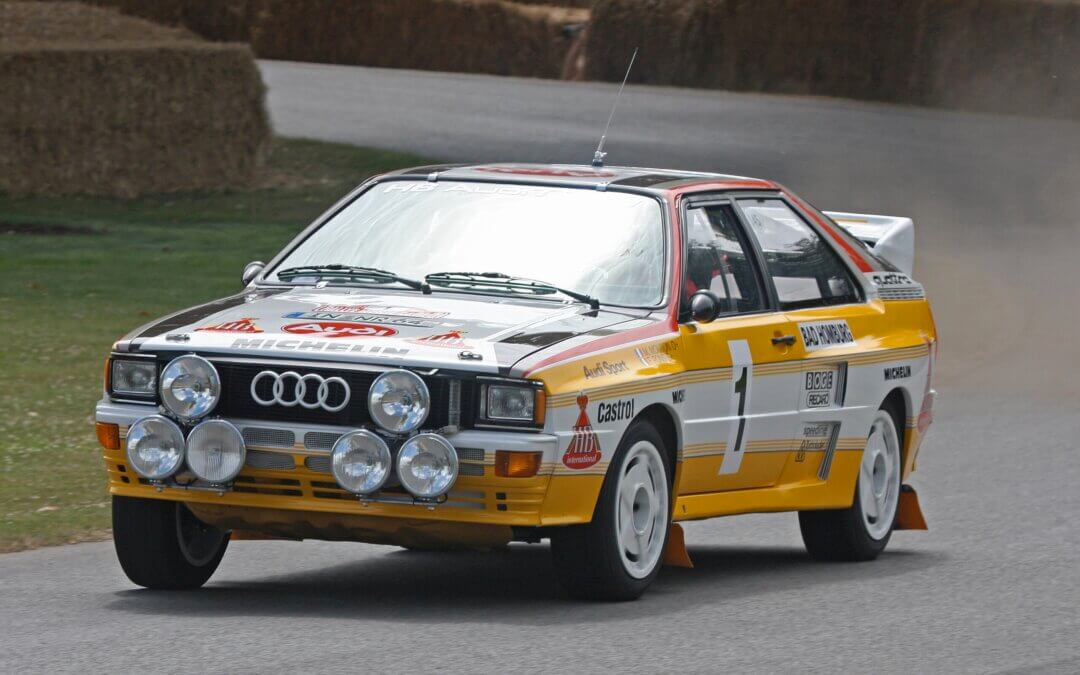
If you want to understand the sheer, unadulterated madness of 1980s rallying, you don’t look at the statistics. You look at the footage. You watch a primitive, boxy beast of a car sliding sideways mere inches from a wall of spectators, spitting fire and gravel like an angry dragon.
And if you look closely at the driver of the most fearsome beast of them all—the Audi Quattro—you won’t see fear. You’ll see a Frenchwoman with piercing black eyes and a right foot heavy enough to shift the axis of the motorsport world.
Michèle Mouton didn’t just drive in the Golden Era of rallying; she defined it. She was a lawyer-in-training who traded the courtroom for the cockpit, and in doing so, forced a male-dominated sport to confront a terrifying truth: the fastest driver on the mountain wasn’t a “he.”
The Girl from Grasse
Mouton’s story begins far from the mud and snow of the World Rally Championship. Born in the perfume capital of Grasse, France, she was studying law when a friend asked her to co-drive. It didn’t take long for her to realize she was in the wrong seat. She wanted the steering wheel.
Her rise was meteoric. By the late 70s, she was wrestling a Fiat 131 Abarth, a car she famously described as “like a truck.” But it was a phone call in 1980 that changed everything. Audi was building something new—a car with four-wheel drive and a turbocharged engine that sounded like a war zone. They wanted Mouton to drive it.
Critics sneered. They called it a publicity stunt. They said the Quattro was too heavy, too complex, and too brutal for a woman. Mouton didn’t argue. She just got in the car.
The Duel of 1982
The 1982 World Rally Championship season remains one of the most dramatic chapters in racing history. It was a heavyweight bout between the clinical German genius Walter Röhrl in his Opel and the fiery Mouton in her Audi.
The narrative was irresistible. Röhrl was the establishment, a man who famously dismissed Mouton’s speed by claiming that a trained monkey could win in an Audi Quattro. Mouton was the disruptor, driving with a flamboyant, aggressive style that matched the raw power of her machine.
She silenced the paddock early, winning in Portugal, then again on the brutal, rock-strewn roads of the Acropolis in Greece, and once more in the stifling heat of Brazil. She wasn’t just participating; she was dominating.
But the season ended in heartbreak. Entering the penultimate round in the Ivory Coast, Mouton was on the verge of the title. Just hours before the start, she received news that her father had died. In a display of superhuman compartmentalization, she told no one but her co-driver, Fabrizia Pons. She drove through the grief, leading the rally by over an hour before a mechanical failure and a crash ended her title hopes. She finished second in the championship—a feat no woman has come close to matching since.
The Queen of the Mountain
If 1982 was her masterpiece, 1985 was her encore. Mouton took the Audi Sport Quattro to the United States for the Pikes Peak International Hill Climb. The “Race to the Clouds” was an American institution, a 12-mile sprint up a gravel mountain road with no guardrails and drops that fell away into eternity.
The American racers were unwelcoming. They resented the European technology and the female interloper. When she was fined for speeding in the pit lane, she was allegedly told she couldn’t start the race with the engine running.
It didn’t matter.
Mouton launched the 500-horsepower Quattro up the mountain, attacking the hairpins with a violence that left spectators gasping. She didn’t just win; she shattered the course record held by Al Unser Jr. When critics suggested her speed was solely due to the car, she offered a retort as sharp as her driving: “If you have the balls, we can race back down as well.”
More Than a Driver
Mouton retired from rallying in 1986, just as the Group B era came to a tragic, fiery end. But she didn’t leave the sport. She became a founding member of the Race of Champions and later the President of the FIA’s Women in Motorsport Commission.
Today, looking back at the graining footage of the 1980s, Michèle Mouton stands out not because she was the “fastest woman,” but because she was simply one of the fastest, period. In a world of adrenaline, gasoline, and danger, she asked for no quarter and gave none.
She proved that the stopwatch is gender-blind. It only knows one thing: how fast you can go before you hit the brakes. And for Michèle Mouton, the answer was always: later than you.