
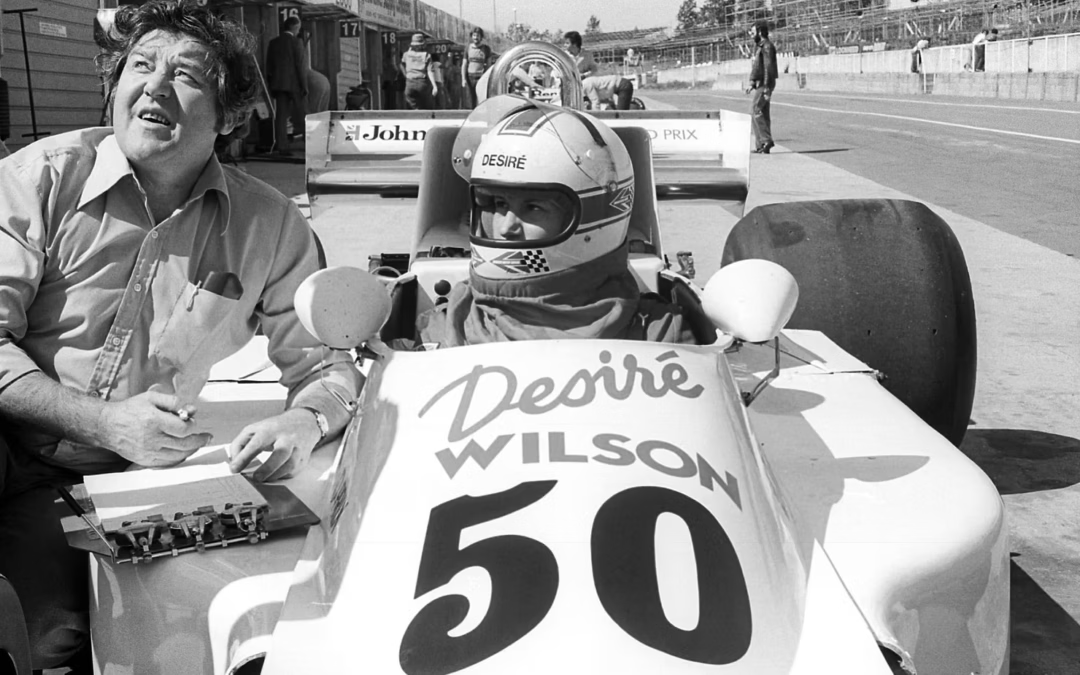
Open the record books of the Formula 1 World Championship, and you will find a stark, empty column. No woman has ever won a Grand Prix. But history is often more nuanced than a spreadsheet, and if you travel to the rolling hills of Kent in England, you will find a different story etched into the asphalt.
There, at the legendary Brands Hatch circuit, is a grandstand named after a driver. It isn’t named for Lewis Hamilton or Nigel Mansell. It is named for Desiré Wilson.
Why? Because on an overcast Easter Monday in 1980, Desiré Wilson did what no other woman has done before or since: she drove a Formula 1 car across the finish line in first place.
The South African Prodigy
Born in Brakpan, South Africa, in 1953, Wilson didn’t just inherit a love for speed; she was born into the pit lane. Her father was a motorcycle champion, and by age 12, she was racing midget cars on dirt ovals. She possessed a natural, fluid speed that quickly outgrew the local scene.
In the 1970s, South Africa had a thriving domestic Formula 1 series, a proving ground that hardened Wilson against formidable competition. She wasn’t just a participant; she was a contender. By the time she arrived in Europe, she had already proven she could handle high-horsepower open-wheelers.
The Miracle at Brands Hatch
The date was April 7, 1980. The series was the Aurora AFX British Formula 1 Championship. While not part of the official World Championship, these were proper F1 cars—roaring 3.0-liter Cosworth DFV engines strapped to ex-Grand Prix chassis.
Wilson was piloting a Wolf WR4, a car that had seen better days. The field was packed with seasoned veterans and hungry up-and-comers. The conditions were tricky, but Wilson was in a league of her own.
She qualified heavily, but it was the race where she truly shone. She took the lead and never looked back, controlling the gap with the precision of a metronome. When the checkered flag fell, she hadn’t just won; she had dominated. The image of Wilson on the podium—trophy held high, flanked by men who had to settle for the lower steps—remains one of the most iconic, yet under-published, photos in motorsport history.
The “What If” of the British Grand Prix
That victory should have been the golden ticket. And for a moment, it seemed like it was. Later that year, she was entered into the official British Grand Prix, the World Championship round held at the very same track, Brands Hatch.
But Formula 1 is a cruel sport defined by equipment. Wilson was given a seat with a privateer team, driving a Williams FW07. On paper, it was a championship-winning car. In reality, it was a hastily prepared chassis that had been used as a replacement car, lacking the updates and aerodynamic skirts that made the factory cars stick to the road.
Despite her intimate knowledge of the track, the car was uncooperative. She failed to qualify by a heartbreakingly slim margin. It was her only shot at a World Championship Grand Prix. The funding dried up, the phone stopped ringing, and the door to F1 slammed shut.
A World-Class Versatility
Wilson refused to let the F1 paddock define her career. If they wouldn’t let her race Grand Prix cars, she would win in everything else.
She pivoted to endurance racing, a discipline that rewards consistency and mechanical sympathy. In 1980, she teamed up with Alain de Cadenet to win the Monza 1000km and the Silverstone 6 Hours. With these victories, she became the first woman to win a World Championship for Makes race.
She crossed the Atlantic to tackle the IndyCar circuit (CART), passing the grueling rookie test at the Indianapolis Motor Speedway—a feat that terrified many lesser drivers. She raced at Le Mans and Sebring, proving time and again that she could drive anything with four wheels and an engine.
The Uncrowned Queen
Desiré Wilson retired from professional racing in the late 1980s, leaving behind a resume that is often criminally overlooked.
Today, the “Wilson Grandstand” at Brands Hatch stands as a silent testament to her achievement. It reminds visitors that while the official F1 record books may say “0 wins” for female drivers, the reality is different.
On that day in 1980, on that track, against those men, Desiré Wilson was the fastest driver in the world. She remains the only woman to stand on the top step of a Formula 1 podium, a singular flash of brilliance that proved, once and for all, that the car doesn’t care who is driving—it only cares how fast you are.