
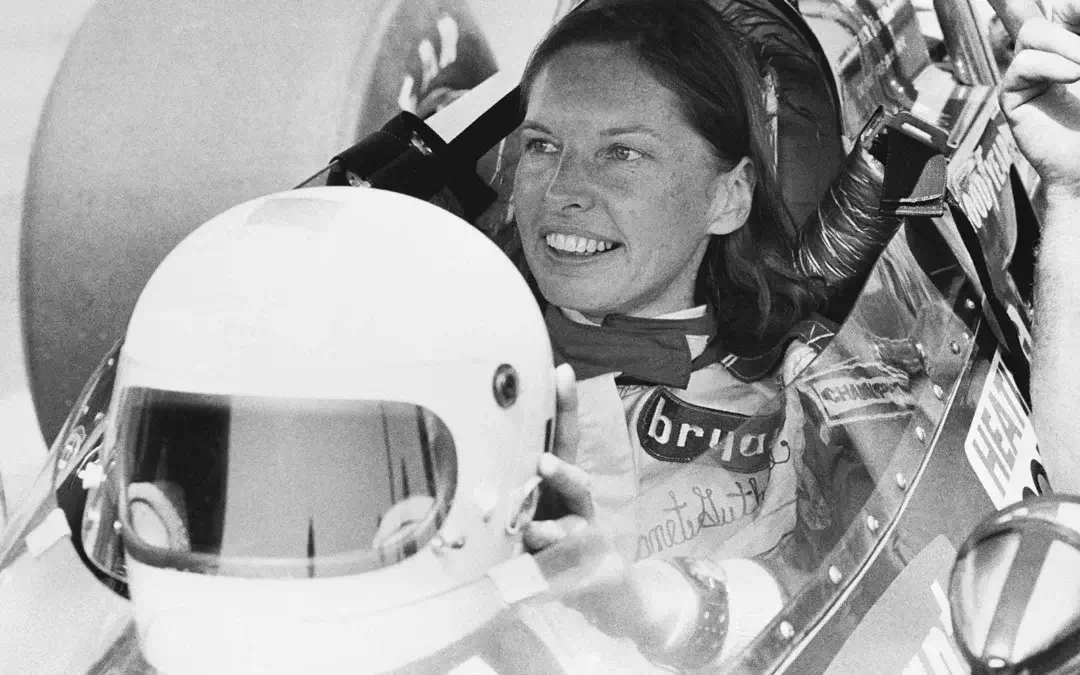
The year was 1977. At the Indianapolis Motor Speedway, the air was thick with methanol fumes and the kind of tension that only history-in-the-making can generate. For decades, the command to ignite the 33 machines on the grid had been a sacred, immutable liturgy: “Gentlemen, start your engines.”
But that year, track owner Tony Hulman had a problem. Among the field of gladiators strapped into their 800-horsepower missiles was a 39-year-old aerospace engineer named Janet Guthrie. She wasn’t there to be a spectacle; she was there because she was fast. Hulman, bowing to the undeniable reality of her qualifying speed, keyed the mic and offered a clumsy but momentous revision: “In company with the first lady ever to qualify at Indianapolis, gentlemen, start your engines.”
Janet Guthrie didn’t just break the glass ceiling of American motorsports; she shattered it at 200 miles per hour.
From the Slide Rule to the Speedometer
To understand Guthrie’s anomaly in the rough-and-tumble world of 1970s racing, you have to look at her resume. Before she was a racer, she was a scientist. Born in Iowa and raised in Florida, Guthrie earned a physics degree from the University of Michigan and worked as a research and development engineer for Republic Aviation. She even made the first cut for NASA’s scientist-astronaut program.
While her peers were wrenching on moonshining coupes in dirt driveways, Guthrie was deriving Maxwell’s equations and working on precursors to Project Apollo. But the thrill of the theoretical couldn’t compete with the visceral reality of speed. She bought a Jaguar XK 120, not to commute, but to tame. “I found physics entrancing,” she would later say. “But driving is living. It’s aggressive instead of passive living.”
By the early 70s, she had traded the laboratory for the track full-time, building her own engines and sleeping in her tow vehicle. She was a privateer in the truest sense, armed with a slide rule mind and a mechanic’s hands.
The Unwanted Pioneer
When Guthrie arrived at Indianapolis in 1976 to test for the 500, the welcome mat was decidedly absent. The skepticism wasn’t just whispers; it was a roar. Drivers and crew members openly questioned if a woman had the strength to handle an Indy car. The hostility was palpable.
She failed to qualify in 1976, but rather than retreat, she pivoted to NASCAR, becoming the first woman to run a superspeedway Cup race. It was a baptism by fire. She didn’t have the best equipment or the big-money sponsors, but she had a relentless, analytical approach to driving. “You drive the car, you don’t carry it,” she famously quipped to those who doubted her stamina.
Her return to Indy in 1977 was the turning point. She qualified 26th, silencing the critics who said it couldn’t be done. But her greatest performance came a year later, in 1978.
The Drive of a Lifetime
The 1978 Indy 500 is where the legend of Janet Guthrie was truly cemented. Two days before the race, she fractured her wrist in a charity tennis match. In an era before power steering, wrestling an Indy car for 500 miles was a brutal physical feat for a healthy driver. For someone with a broken wrist, it should have been impossible.
Guthrie didn’t tell the team. She didn’t tell the press. She secretly wore a cast, hid it under her racing suit, and climbed into the cockpit. She drove for three hours in excruciating pain, steering with her left hand and shifting with her right. She finished ninth.
It remains one of the grittiest performances in the history of the Speedway. That top-ten finish stood as the best by a woman for nearly 30 years, until Danica Patrick’s arrival in 2005.
A Legacy Beyond the Finish Line
Despite her talent, Guthrie’s career was cut short not by a lack of skill, but by a lack of funding. Sponsorship was the lifeblood of racing, and corporate America in the early 80s wasn’t ready to bet big on a female driver. She was forced into retirement in 1980, a “what if” story that still stings.
Today, Guthrie’s helmet and suit reside in the Smithsonian, artifacts of a revolution she started almost single-handedly. She didn’t just open the door for women in racing; she kicked it down with a physics degree in her back pocket and a lead foot on the pedal.
In a sport defined by noise and bravado, Janet Guthrie let her driving do the talking. And if you listen closely to the history of the Brickyard, her engine still roars louder than the doubts ever did.