
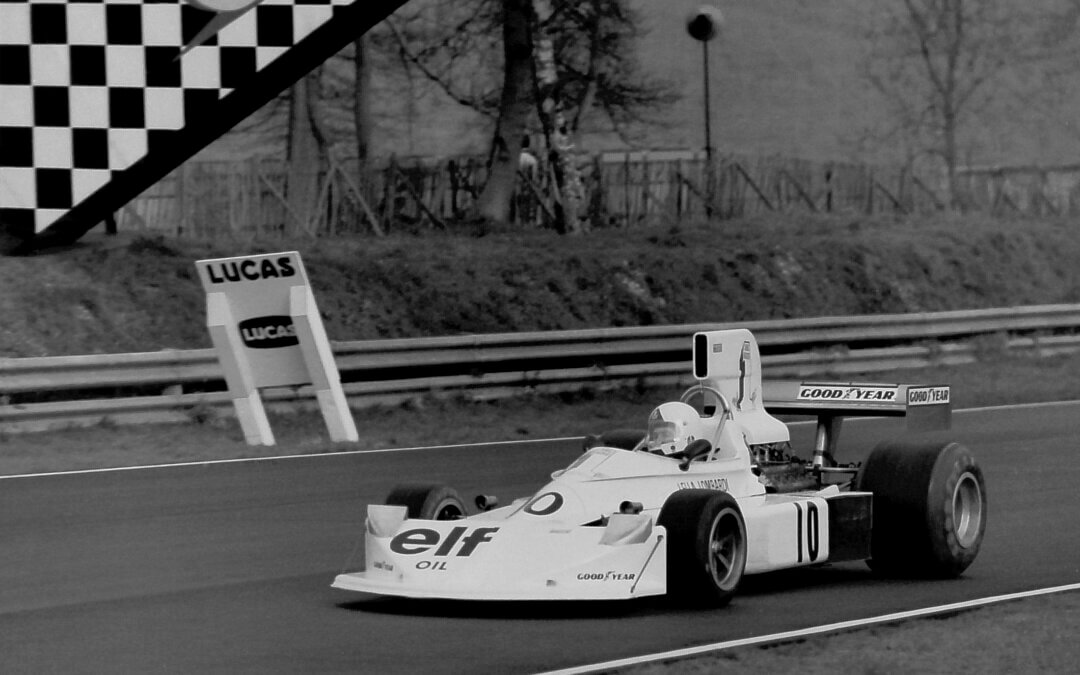
The Butcher’s Daughter Who Tamed the Bullring: Remembering Lella Lombardi
Formula 1 in the mid-1970s was a theater of the absurd and the dangerous. It was an era of sideburns, unbridled horsepower, and a cavalier attitude toward mortality. Into this testosterone-fueled circus walked a woman who didn’t care for the spotlight, didn’t play to the galleries, and certainly didn’t fit the mold of a “pit lane dolly.”
Her name was Lella Lombardi, and she wasn’t there to smile for the cameras. She was there to race.
From Deliveries to the Grid
To understand Lombardi’s improbable rise, you have to look past the glamour of Monaco and Monza to the small Italian town of Frugarolo. Born Maria Grazia Lombardi in 1941, she wasn’t groomed for the podium from birth. She was the daughter of a butcher.
Her racing school wasn’t a go-kart track; it was the winding country roads of Piedmont, where she wrestled the family’s delivery van, hauling sides of beef with a speed that likely unnerved the local clientele. While other aspiring drivers were courting sponsors at cocktail parties, Lombardi was saving every lira she earned to buy a used car. She was a self-made speed demon, possessing a grit that would later earn her the nickname “The Tigress of Turin”—a misnomer, as she wasn’t from Turin, but the “Tigress” part fit her aggressive driving style perfectly.
The Chaos of Montjuïc
The date that etched Lombardi’s name into history was April 27, 1975. The setting was the Spanish Grand Prix at Montjuïc Park in Barcelona—a terrifying street circuit lined with armco barriers that the drivers famously deemed lethal.
The weekend was a disaster before a single engine fired. Fearing for their lives due to loose barriers, the drivers threatened to strike. They were threatened with legal action and police seizure of their cars in return. The race went ahead under a cloud of doom.
In the midst of this madness, Lombardi, driving a March 751, kept her head down. While champions like Emerson Fittipaldi parked their cars in protest and others crashed out on the treacherous surface, Lombardi drove a steady, rhythmic race.
Then, tragedy struck. The rear wing of Rolf Stommelen’s car failed, sending him flying into the crowd, killing five spectators. The race was stopped on lap 29. Amidst the horror and confusion, the officials tallied the positions. Lella Lombardi was in sixth place.
Because the race was cut short, only half-points were awarded. Lombardi received 0.5 championship points—making her the first, and to this day the only, woman to score points in the Formula 1 World Championship. It was a record born of tragedy, but earned through sheer survival instinct.
More Than a Statistic
History often reduces Lombardi to that single half-point, a trivial pursuit answer. But that reduction does a disservice to her versatility. She wasn’t a flash in the pan; she was a racer’s racer.
After her F1 stint, she didn’t retreat. She went endurance racing. She tackled the 24 Hours of Le Mans, finishing an impressive second in her class in 1976. She even crossed the Atlantic to race in NASCAR, running the Firecracker 400 at Daytona against the likes of Richard Petty and Cale Yarborough.
She was a privateer in life as much as on the track. In an era where being openly gay was taboo, she lived quietly with her partner, Fiorenza, shielding her private life with the same fierce protectiveness she applied to her racing line. She had no interest in being a symbol or a crusader for gender politics. “I prefer to have an accident than to fall in love,” she once quipped—a deflection designed to keep the press at bay so she could focus on the tachometer.
The Silent Pioneer
Lombardi passed away from cancer in 1992, just shy of her 51st birthday. She left behind a legacy that is often underappreciated. She didn’t have the media machine of Danica Patrick or the financial backing of modern academy drivers. She had a delivery van, a heavy right foot, and an inability to hear the word “no.”
Fifty years after her historic drive in Barcelona, the “0.5” next to her name remains a lonely statistic in the F1 record books. But for those who know the sport, it stands as a monument to the butcher’s daughter who didn’t just knock on the door of the boys’ club—she kicked it down, took a seat, and drove.