
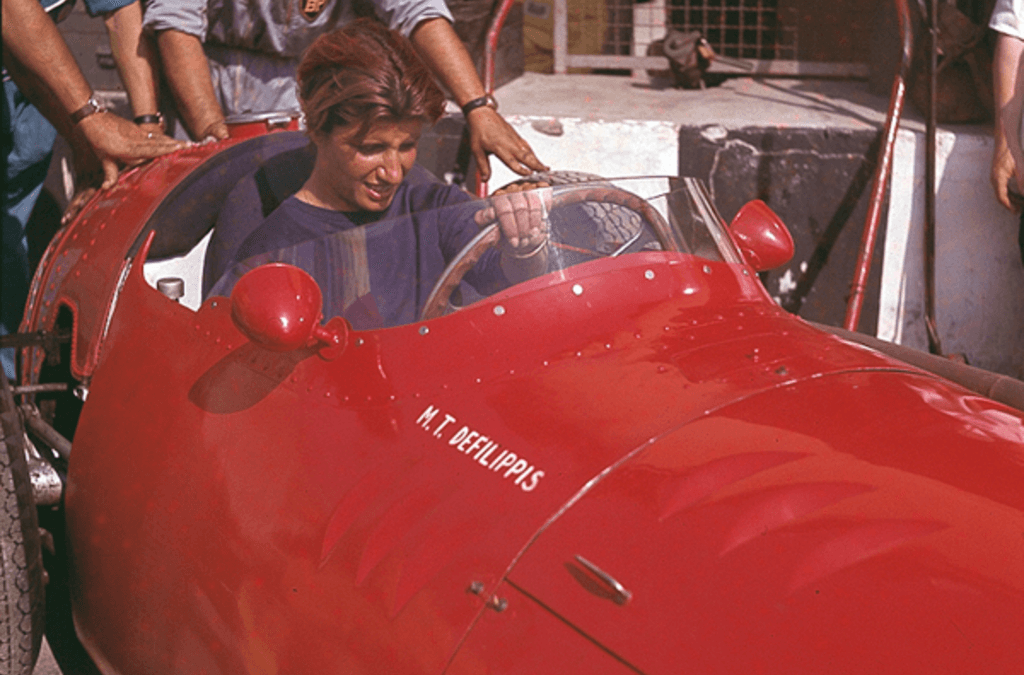
The Countess Who Bet Against the Boys: The Story of Maria Teresa de Filippis
In the monochromatic newsreels of 1950s motor racing, the cast is almost exclusively male. It is a world of oil-stained goggles, leather helmets, and a nonchalant acceptance of death. But if you freeze the frame at the 1958 Belgian Grand Prix, you will spot an anomaly.
Sitting in the cockpit of a Maserati 250F—the very same chassis Juan Manuel Fangio had used to conquer the world—was a 31-year-old Neapolitan countess. She wasn’t a grid girl. She wasn’t a spectator. Maria Teresa de Filippis was about to do what no woman had ever done: drop the clutch and race in Formula 1.
A Wager on Speed
Maria Teresa de Filippis did not grow up dreaming of checkered flags. Born in Naples in 1926, she was a keen equestrian, more comfortable in a saddle than a bucket seat. Her entry into the high-octane world of motorsport began, as many great Italian stories do, with a sibling rivalry.
In 1948, her two brothers taunted her, betting that she would be too slow to handle a car at speed. Fiercely competitive, the 22-year-old Maria Teresa entered the Salerno-Cava de’ Tirreni hill climb driving a humble Fiat 500. She didn’t just finish; she won her class.
The bet was won, but the addiction had set in. The horses were replaced by horsepower. She climbed the ladder of Italian road racing, eventually earning a factory drive with Maserati. She was known as “La Pilotessa,” a nickname that was equal parts affectionate and bewildered.
Taming the Beast
By 1958, de Filippis had set her sights on the pinnacle: Formula 1. She purchased a Maserati 250F privately. It is difficult to overstate the physical brutality of this machine.
The 250F had no power steering, no seatbelts, and a front-mounted engine that roasted the driver’s legs. The tires were thin, the brakes were drum, and the tracks were lined with trees and ditches, not tire barriers. To drive it required immense upper body strength and a total disregard for self-preservation.
Her debut came at Spa-Francorchamps in Belgium, one of the most terrifying circuits on Earth. She qualified 19th and finished 10th. It was a respectable, solid drive in an era where mechanical reliability was a roll of the dice. She had proven she belonged.
“The Only Helmet a Woman Should Wear…”
However, speed could not outrun prejudice. The most infamous moment of her career occurred later that year at the French Grand Prix.
De Filippis traveled to Reims, ready to race, only to be barred from competing by the race director, Toto Roche. His reasoning was delivered with a chauvinism that leaves modern jaws on the floor: “The only helmet a woman should wear is the one at the hairdresser’s.”
It was a crushing, humiliating public rejection. Yet, de Filippis handled it with the stoicism of nobility. She didn’t rage; she simply packed up and looked for the next race.
The Silence of the Engines
Ultimately, it wasn’t sexism that drove her away from the track—it was grief. The late 1950s were a bloodbath for Formula 1 drivers. In 1958 and 1959, the sport lost legends like Luigi Musso, Peter Collins, and Mike Hawthorn.
The final straw came in August 1959 at the AVUS circuit in Berlin. Her close friend and mentor, Jean Behra, was killed while driving the Porsche that de Filippis was scheduled to drive later.
Devastated by the loss of yet another friend, she walked away. “Too many friends had died,” she later said. She turned her back on the sport for 20 years, raising a family and leaving the cockpit behind.
The First of the Few
Maria Teresa de Filippis died in 2016 at the age of 89. For decades, her legacy was a quiet one, a footnote in the history books. But as the only woman to race in F1 for 15 years (until Lella Lombardi arrived), she remains the matriarch of speed.
She was a racer who drove not for fame or feminist statements, but for the pure, visceral thrill of proving her brothers wrong. In doing so, the Countess showed the world that courage has no gender—and that a woman’s place is wherever she decides to put the pedal down.