
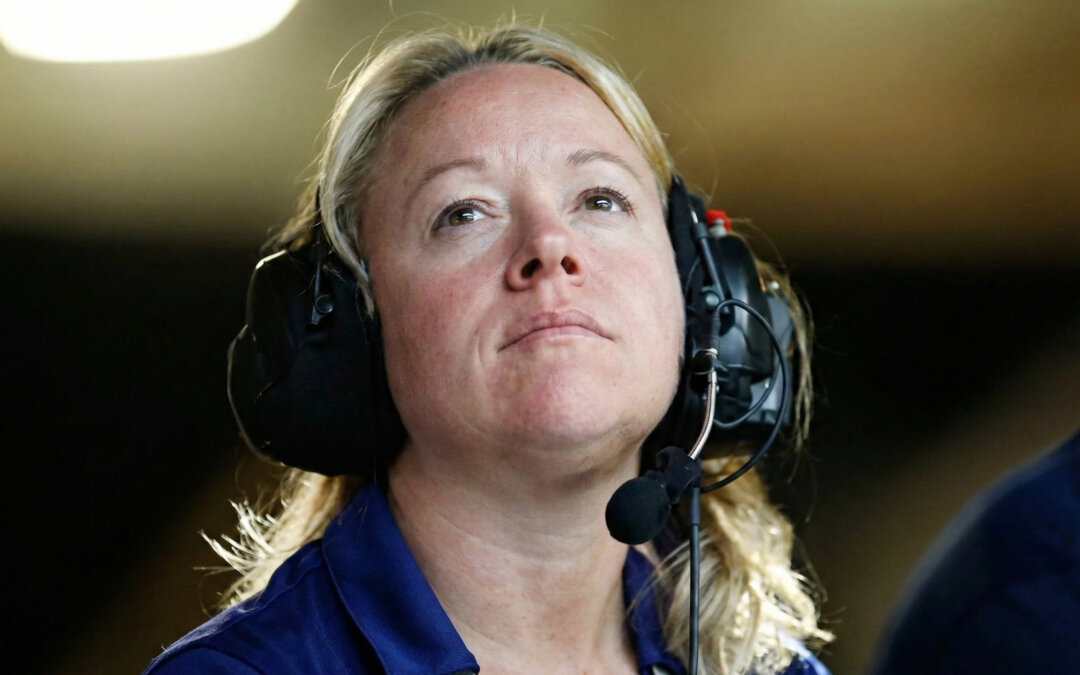
She grew up sleeping under workbenches while her father built race cars. Today, Catherine Crawford isn’t just carrying the family torch—she’s using it to weld together one of the most respected careers in modern sports car racing. From aerodynamics to team management, this is how she became the engineer everyone wants in their pit box.
In the high-stakes world of IMSA and professional sports car racing, last names often carry weight. But if you walk into the paddock and ask for “Crawford,” you better be specific. While her father, Max Crawford, built a carbon-fiber empire with Crawford Composites, Catherine Crawford has carved out her own lane—one defined by downforce, data, and a relentless pursuit of speed.
She is a rarity in a sport that is still catching up to the 21st century: a woman who is not just an engineer, but a true “racer’s engineer”—someone who can design a wing, run a simulation, and call a race strategy, all before lunch.
Born in the Autoclave
For most kids, a playground is a swing set. For Catherine Crawford, it was the shop floor of Crawford Composites in North Carolina.
“I literally grew up in the shop,” Crawford has said in interviews. Her childhood was scored by the hiss of autoclaves and the smell of curing resin. This wasn’t just exposure; it was an apprenticeship. By the time she was a teenager, she understood the fundamental language of race cars: stiffness, weight, and airflow.
But she didn’t just inherit a job; she earned her credentials. She pursued a degree in Aerospace Engineering from North Carolina State University, specializing in aerodynamics. She wasn’t looking for a free ride—she was looking for the answers to why her father’s cars worked the way they did.
The Aero Ace
Crawford’s reputation was built on her mastery of the invisible: the wind.
Her work as an aerodynamicist has been instrumental for some of the biggest programs in American racing. She cut her teeth working with heavy hitters like Panoz and Ganassi Racing. When you see a prototype sticking to the tarmac at 180 mph at Daytona, there’s a good chance Crawford’s fingerprints are on the aero map.
Her skill set is uniquely hybrid. She can sit in front of a CFD (Computational Fluid Dynamics) screen and optimize a splitter, but she can also stand on the timing stand and interpret what the driver is feeling. This bridge between the theoretical and the practical is what makes her lethal.
Calling the Shots
In recent years, Crawford has stepped out from behind the computer screen and onto the pit box. As a race strategist and team principal (most notably running the Crawford high-performance programs and managing entries in series like IMSA Prototype Challenge), she has proven she can manage the human element as well as the mechanical one.
She was a key force behind the Crawford F4 car, a vehicle designed to train the next generation of open-wheel talent. Here, her role wasn’t just about making a fast car, but a safe and reliable one—engineering the very platform that launched careers.
Perhaps her most high-profile recent role has been her engineering leadership within teams running the Ligier chassis in IMSA. When a car is struggling with balance during a practice session, Crawford is often the calm voice on the radio, translating driver complaints into suspension tweaks.
The Next Generation
Catherine Crawford represents a crucial evolution in the “Women in Motorsport” narrative. She isn’t a driver, and she isn’t a PR rep. She is the technical authority. When she speaks, mechanics listen—not out of chivalry, but because she knows more about the Reynolds number of the rear wing than anyone else in the room.
In a sport that is finally starting to look at talent over gender, Crawford is a beacon. She proves that while you can be born into racing, you have to engineer your own success.
The Crawford File
-
Education: B.S. Aerospace Engineering, NC State University.
-
Specialty: Aerodynamics, Composite Design, Race Strategy.
-
Key Associations: Crawford Composites, Panoz, Chip Ganassi Racing, IMSA.
-
Signature Project: Development of the Crawford F4 chassis; lead engineer for various LMP2/LMP3 programs.