
In the gritty, high-octane world of 1950s motorsport, there were two types of people: those who drove the cars and those who wrote about them. The drivers were gladiators; the writers were spectators. The two tribes rarely mixed, separated by the armco barriers and the distinct smell of fear.
And then there was Denise McCluggage.
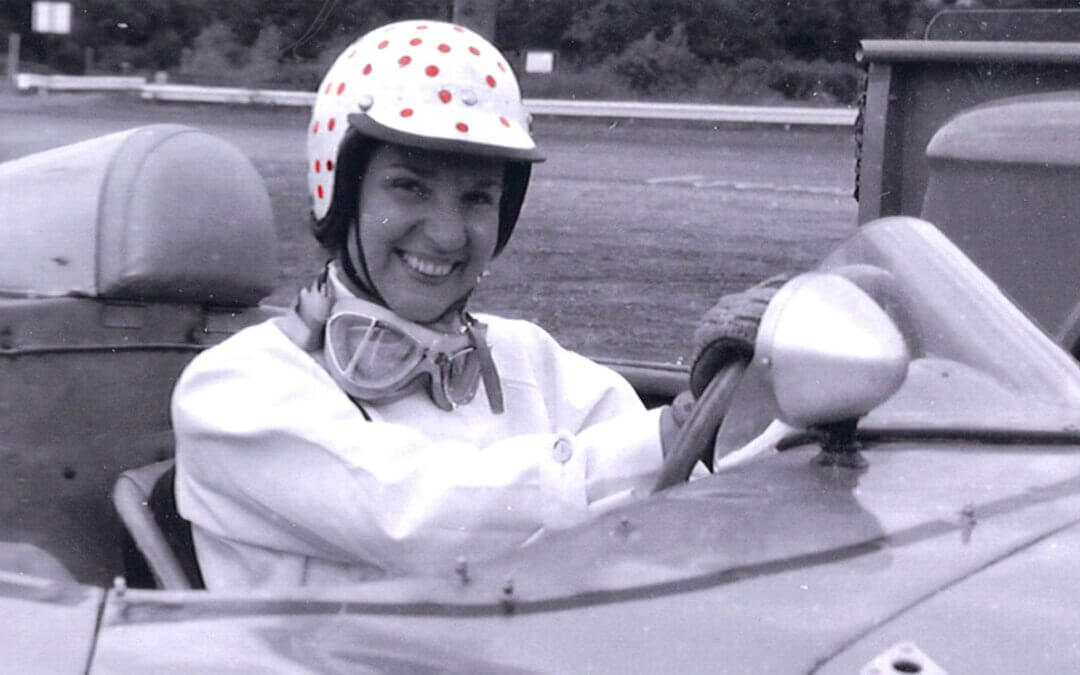
She was the anomaly who refused to choose a side. With a typewriter in the passenger seat and a pink polka-dot helmet on her head, she didn’t just cover the golden age of racing; she lived it. She was the only person in the paddock who could drift a Ferrari 250 GT through a hairpin turn and then file a 1,000-word column about the suspension dynamics before the engine had even cooled.
The Reporter Who Wouldn’t Stay Put
Born in Kansas in 1927, McCluggage began her career as a journalist at the San Francisco Chronicle and later the New York Herald Tribune. In an era when female reporters were expected to stick to society pages and garden shows, McCluggage forced her way into the sports department. She covered skiing, parachuting, and eventually, the burgeoning sports car scene.
But the role of the passive observer bored her. “I think you have to do it to really understand it,” she famously said. So, she bought an MG TC—the gateway drug of British roadsters—and entered her first race.
She didn’t just participate; she was fast. Naturally, fluidly fast.
Racing with the Giants
McCluggage’s racing resume reads like a fantasy draft of vintage motorsport. She didn’t race in the “ladies’ cup”; she raced against the men, often beating them.
Her crowning achievement came at the 12 Hours of Sebring in 1961. Driving a Ferrari 250 GT SWB—a car now worth tens of millions of dollars—she and her co-driver, jazz musician Allen Eager, won the GT category.
She rallied a Ford Falcon in the grueling Monte Carlo Rally. She wrestled Porsches and Maseratis. She became a fixture in the winner’s circle, her signature white helmet with pink polka dots becoming a symbol of excellence that demanded respect.
The Insider
What made McCluggage truly unique was her access. Because she was a fellow competitor, the legends of the sport—Juan Manuel Fangio, Stirling Moss, Phil Hill—didn’t treat her like a reporter. They treated her like one of their own.
She was part of the inner sanctum. She could critique a driver’s line because she had taken the same corner at 100 mph an hour earlier. Her prose in the New York Herald Tribune and later in Competition Press (the publication she founded, which became AutoWeek) elevated automotive journalism from dry technical reports to literary art. She captured the romance, the danger, and the humor of the circus.
She even played a pivotal role in American culture beyond the track; she is often credited with helping introduce a young Steve McQueen to the world of racing, fueling the obsession that would define his public image.
The Glass Wall at Indy
Despite her success, the sexism of the era was an omnipresent wall. The most stinging example was the Indianapolis 500. For decades, women were strictly forbidden from entering the garage area or the pits—even accredited journalists like McCluggage.
While her male colleagues walked freely among the cars, McCluggage had to conduct interviews through a chain-link fence, standing on a box to hear the drivers. It was a humiliating exclusion for a woman who had conquered Sebring, yet she persisted, filing her stories with a grace that belied the frustration she must have felt.
The Grand Dame of Motoring
Denise McCluggage passed away in 2015 at the age of 88. By then, she had been inducted into the Automotive Hall of Fame—the very first journalist to receive the honor.
She left behind a legacy that bridged the gap between the cockpit and the newsstand. She showed the world that a woman could be sophisticated, intellectual, and utterly fearless all at once.
In her writing, she often spoke of the “flow”—that magical state where car and driver become one. Denise McCluggage found that flow in two worlds simultaneously, mastering the art of the sentence and the art of the apex with equal brilliance. She was, quite simply, the fastest writer who ever lived.