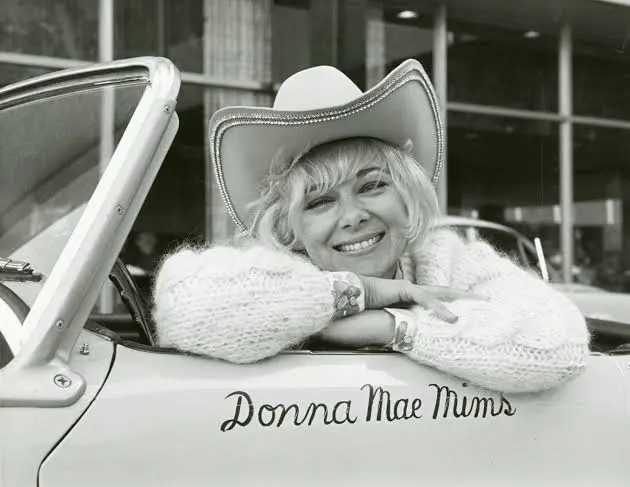
She wore pink coveralls, drove a pink car, and had “THINK PINK” painted on her rear bumper—mostly so the men she passed would have something to read. In the macho world of 1960s motorsport, Donna Mae Mims didn’t just break the glass ceiling; she smashed it in a Corvette.
If you walked through the pits of an SCCA race in 1963, you would be greeted by a sea of grease-stained denim, white t-shirts, and the overwhelming scent of testosterone. But if you looked closely at the grid, you’d spot a splash of bubblegum brilliance cutting through the gloom.
There, behind the wheel of a bug-eyed Austin-Healey Sprite, sat a woman with bleached blonde hair, pink driving gloves, and a smile that said she knew something you didn’t.
This was Donna Mae Mims. And she was about to teach the boys a lesson.
History in High Gear
Mims is often remembered for her eccentric style, but reducing her to her wardrobe does a disservice to her right foot. In 1963, she did the unthinkable: she won the SCCA H-Production National Championship.
It wasn’t a “ladies cup.” It wasn’t a publicity stunt. It was a season-long war of attrition against the best amateur racers in the United States. When the dust settled, Mims became the first woman in history to win an SCCA national title.
She didn’t just race against men; she beat them, and she did it while unapologetically embracing her femininity.
“I was always a pink girl. I had pink convertibles, pink clothes. So when I started racing, it just made sense. If I was going to be out there, I was going to be me.” — Donna Mae Mims
The Yenko Connection
Based in Pittsburgh, Mims wasn’t just a weekend warrior; she was embedded in the heart of American muscle. She worked as an executive secretary at Yenko Chevrolet, the legendary dealership famous for turning standard Camaros and Corvettes into street-legal monsters.
Don Yenko, a racing legend himself, didn’t view Mims as a novelty. He viewed her as a teammate. She piloted Yenko-tuned Corvettes and even a Sunbeam Tiger, earning the respect of the serious “car guys” of the era.
But she never compromised on the brand. Her cars were painted pink. Her helmet was pink. And on the back of her race cars, she painted “THINK PINK”—a taunt reserved for the competitors trailing in her wake.
The Cannonball Rebel
If her SCCA title proved her skill, her participation in the 1972 Cannonball Run proved her spirit.
The Cannonball Baker Sea-to-Shining-Sea Memorial Trophy Dash was an outlaw race from New York to California. It was dangerous, illegal, and culturally anarchic. Naturally, Mims had to be there.
She teamed up with fellow racer Judy Stropus to pilot a 1972 Cadillac limousine. Their plan? To drive the entire distance without stopping, fueled only by grit and determination. Though they DNF’d due to a crash (spilling the green organic broccoli soup they had packed all over the interior), their entry became legendary.
In fact, Mims’ character was so larger-than-life that she was immortalized in the 1981 film The Cannonball Run. Farrah Fawcett’s character? Loosely based on the Pink Lady herself.
A Legacy of Color
Donna Mae Mims passed away in 2009, but her legacy is vibrant. At her funeral, per her request, her body was displayed seated in her 1979 pink Corvette. It was a final, fabulous lap for a woman who lived life at redline.
Today, as we see drivers like Doriane Pin and Iron Dames bringing “hot pink” back to the podiums of Le Mans and F1 Academy, it’s worth remembering who mixed the paint first. Donna Mae Mims proved that you don’t have to be one of the boys to beat them. You just have to be fast.
The Mims File
-
Born: 1927
-
Died: 2009
-
Nickname: “The Pink Lady”
-
Famous Cars: 1959 Austin-Healey Sprite (“Dr. No”), Yenko Stinger, Chevrolet Corvette.
-
Defining Moment: 1963 SCCA Champion (first woman).
-
Motto: “Think Pink.”